
On this page
Legal Guidance for Court Marriage and Free-Will Nikah Across Pakistan
Court Marriage in Pakistan with Nikah, Documentation, Registration and City-Specific Legal Assistance
Court Marriage Services is the specialised matrimonial legal-services platform of Qanoon Group. We assist legally eligible couples with free-will Nikah, document review, Nikah Nama completion, registration guidance and related family-law issues in Karachi, Lahore, Islamabad, Rawalpindi, Multan, Faisalabad and other parts of Pakistan.
In Pakistan, the expression “court marriage” is commonly used for a private, legally documented marriage arranged by adults who are marrying by their own choice. For Muslim couples, it is not a separate statutory form of marriage created by a special “Court Marriage Act”, and it does not ordinarily require the Nikah to be performed inside a courtroom. The marriage must satisfy the applicable Muslim personal-law requirements and the relevant statutory rules concerning age, registration and documentation.
Need city-specific assistance? Review the relevant city guide below or use our Contact Us page for an eligibility and document review before a Nikah date is fixed.
Legal content reviewed: 16 September 2026.
Is Court Marriage Legal in Pakistan?
Yes, adults who are legally competent to marry may marry by their free choice, subject to the personal law applicable to them and the statutory requirements in force in the relevant province or territory. For Muslim marriages, the Muslim Family Laws Ordinance, 1961 provides the statutory registration framework. Section 5 requires every marriage solemnised under Muslim law to be registered in accordance with the Ordinance.
A lawyer, Nikah Khawan, Nikah Registrar and local authority may each have a different role. A lawyer can advise on eligibility, documents, free-will concerns, previous marriages, Wakalatnama, registration and protection issues. A Nikah Khawan solemnises the Nikah. A licensed Nikah Registrar performs the statutory registration functions for the relevant area, and the competent local authority maintains the civil-registration record.
Court Marriage Does Not Usually Mean a Courtroom Ceremony
Despite the name, a court marriage is not performed by a judge. A Muslim free-will Nikah is usually solemnised at a lawyer’s office, the Nikah Registrar’s office, a home or another suitable venue, and then registered with the Union Council.
A court becomes involved only where there is a separate legal issue, such as harassment, a habeas corpus petition, an age or identity dispute, or the dissolution of an earlier marriage.
Minimum Marriage Age in Pakistan in 2026
The minimum age depends on the province or territory where the marriage takes place:
| Jurisdiction | Minimum age currently applied | Current legal position |
|---|---|---|
| Punjab | 18 for both parties | Punjab Child Marriage Restraint Act, 2026 |
| Sindh | 18 for both parties | Sindh Child Marriages Restraint Act, 2013 |
| Islamabad Capital Territory | 18 for both parties | Islamabad Capital Territory Child Marriage Restraint Act, 2025 |
| Balochistan | 18 for both parties | Balochistan Child Marriages Restraint Act, 2025 |
| Khyber Pakhtunkhwa | 18 for males; 16 for females | Child Marriage Restraint Act, 1929 |
Age should be checked from the CNIC, NICOP or passport before any date is fixed. See our Legal Age for Marriage in Pakistan guide.
Basic Legal Requirements for a Muslim Court Marriage
- both parties have reached the minimum age that applies where the marriage takes place;
- both consent freely, without pressure or threats;
- neither is within the prohibited degrees of relationship;
- offer and acceptance (Ijab-o-Qabool) before the required witnesses;
- an agreed Mahr (dower);
- for a woman married before, the earlier marriage has lawfully ended and her iddat is complete;
- for a man who is already married, the Arbitration Council’s prior permission (section 6, MFLO);
- registration of the Nikah Nama under section 5 of the Muslim Family Laws Ordinance 1961.
Witness Requirements Are Not One Universal Formula
Witness requirements depend on the parties’ school of thought. Under Sunni (Hanafi) practice two adult Muslim men, or one man and two women, are usual; Shia requirements differ. The witnesses’ details are entered in the Nikah Nama, so they should bring their CNICs. See Shia and Sunni Nikah.
Is a Bride’s Free-Will Affidavit Always Mandatory?
No. There is no nationwide rule that every adult Nikah needs an affidavit. A free-will declaration is useful where a family objects or a false allegation is likely, because it records the bride’s consent. It does not replace the Nikah, the Nikah Nama or registration.
Documents Commonly Reviewed for Court Marriage
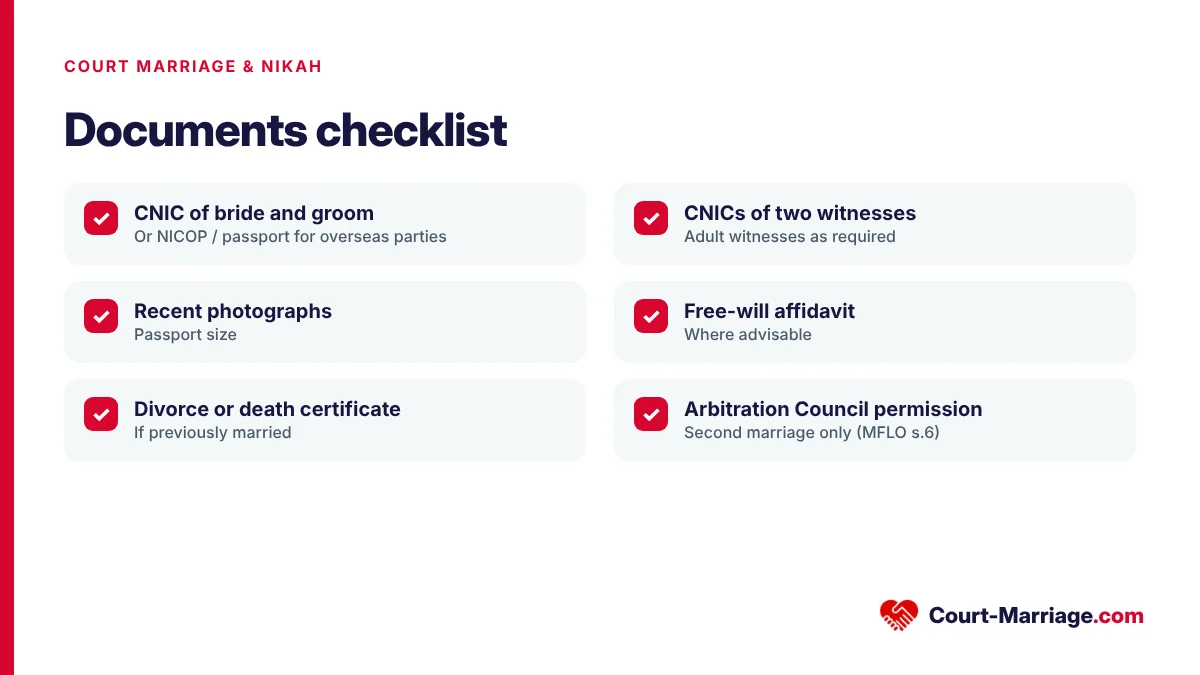
- CNIC, NICOP or passport of the bride and groom;
- CNICs of the witnesses;
- recent photographs, where required;
- divorced: the divorce certificate issued by the Union Council, or the Family Court decree for Khula or dissolution;
- widowed: the death certificate of the former spouse;
- husband already married: the Arbitration Council’s written permission;
- overseas Pakistanis: NICOP or passport, and an attested Wakalatnama if a Vakeel will act for them;
- foreign nationals: a valid passport and visa or Proof of Registration card, and any document their embassy requires (see foreign nationals).
A B-Form is not proof of adulthood and cannot be used to get around the minimum-age law.
Step-by-Step Court Marriage Process in Pakistan
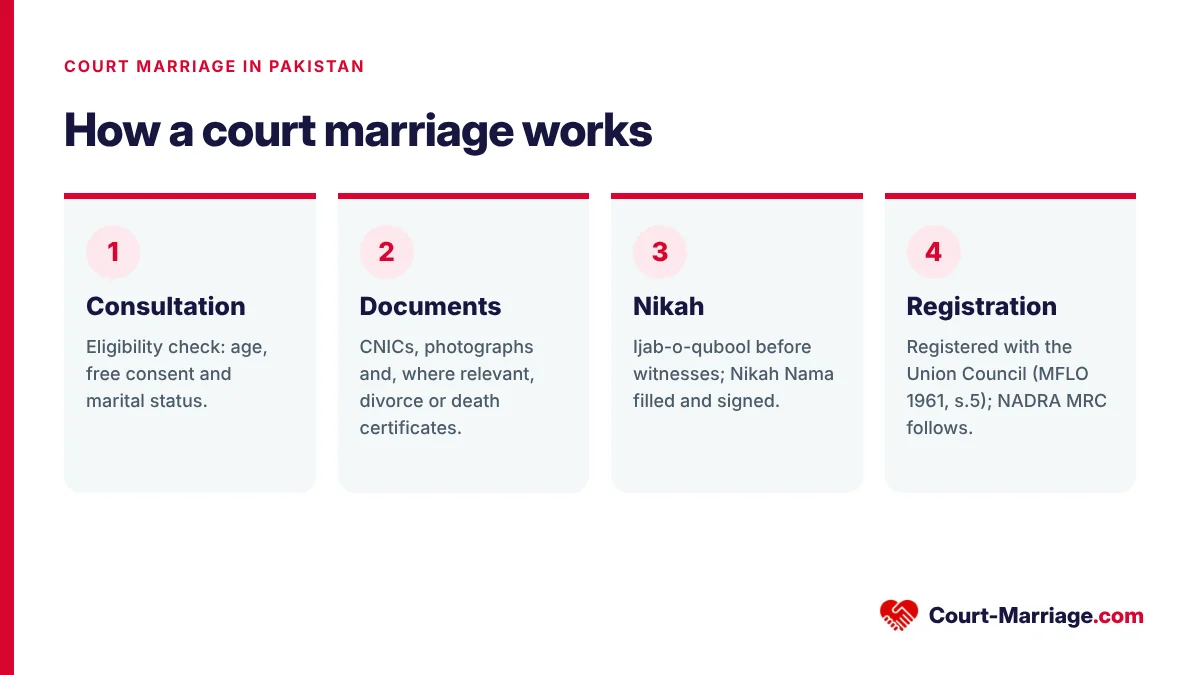
1. Eligibility and Jurisdiction Review
Age, identity, religion, marital status, free consent and the place of the Nikah are checked first, because age laws differ by province.
2. Document Review and Case-Specific Declarations
Identity documents and any earlier-marriage records are reviewed. An affidavit, Wakalatnama, translation or attestation is prepared only where the case needs it.
3. Nikah Solemnisation
The Nikah is performed under the parties’ personal law: Ijab-o-Qabool, the agreed Mahr and the required witnesses or Vakeel.
4. Nikah Nama Completion
The prescribed Nikah Nama is filled in and checked (names, parentage, CNIC or passport numbers, addresses, marital status, Mahr and any delegated right of divorce) before signing. See Nikah Nama clauses explained.
5. Statutory Marriage Registration
Section 5 of the Muslim Family Laws Ordinance 1961 requires every Muslim marriage to be registered. The licensed Nikah Registrar registers the Nikah Nama with the Union Council; if someone else performed the Nikah, it must be reported to the Nikah Registrar. Not registering is an offence, but it does not make the Nikah void.
6. MRC and Later Civil-Record Work
After registration, the Union Council issues the computerised NADRA Marriage Registration Certificate (MRC). Updating CNIC marital status, the Family Registration Certificate, MOFA attestation and embassy use are separate later steps. See update CNIC marital status.
Does NADRA Register the Marriage?
No. NADRA does not perform or decide the marriage. The Nikah Registrar registers it with the Union Council, and the Union Council then issues the computerised certificate through NADRA’s system. That is why it is often called the “NADRA marriage certificate”. See NADRA Marriage Registration Certificate and MRC vs Nikah Nama.
Court Marriage Fees in Pakistan
There is no fixed nationwide fee for court-marriage assistance. The work depends on the city, the documents, any earlier marriage, overseas or foreign-national papers, a Wakalatnama and the registration steps. Send the basic facts on WhatsApp 0333-1127834 for a case-specific quotation. Government charges, translation and attestation costs, if any, are separate.
How Long Does Court Marriage Take?
The Nikah can often be arranged once eligible adults have complete documents. Registration, the MRC, CNIC updates and attestation are handled by different authorities, so no one can promise when every step will be finished.
Court Marriage for Overseas Pakistanis
If one party is abroad, they can appoint a Vakeel through a Wakalatnama and follow the Nikah by video call. A Wakalatnama signed abroad is usually attested by the Pakistani embassy or consulate, or notarised and legalised. See Online Nikah and Online Marriage in Pakistan.
Planning a Court Marriage in Pakistan from Overseas
If you are travelling to Pakistan to marry, decide where the Nikah and registration will take place, and share your travel dates and documents (including any earlier-marriage papers) in advance, so that problems can be sorted out before you arrive. If the documents will be used abroad, ask the receiving country which translations and attestations it needs.
Second Marriage and Section 6 of the Muslim Family Laws Ordinance
A man who already has a wife needs the prior written permission of the Arbitration Council under section 6 of the MFLO before marrying again. The application goes to the Union Council Chairman. Marrying without permission is an offence and has consequences for the existing marriage, including the existing wife’s Mahr.
Previously Married Parties
Divorced and widowed people can remarry once the earlier marriage has lawfully ended. Bring the Union Council divorce certificate, the Family Court decree, or the death certificate. A woman must have completed her iddat. A verbal statement that a marriage has ended is not enough. See remarriage documents and NADRA divorce certificate.
Interfaith and Non-Muslim Marriages
The MFLO applies to Muslim marriages. Christian marriages are governed by the Christian Marriage Act 1872, and Hindu and other marriages by their own laws. Inter-faith cases need a separate legal review of each party’s religion and the registration route. See Christian court marriage.
City-Specific Court Marriage Guides
- Court Marriage in Karachi: Sindh law and Karachi registration
- Court Marriage in Lahore: Punjab law and Lahore procedure
- Court Marriage in Islamabad: ICT law and Islamabad registration
- Court Marriage in Rawalpindi: Punjab law and Rawalpindi procedure
- Court Marriage in Faisalabad and Court Marriage in Multan
- Nikah Khawan: Islamabad · Rawalpindi · Lahore · Faisalabad · Multan
- Also: Court Marriage in Urdu · Procedure guide · Court marriage form
Contact Court Marriage Services
- WhatsApp: 0333-1127834
For any city, use our Contact Us page and say where the Nikah and registration are to take place.
Frequently Asked Questions About Court Marriage in Pakistan
1. Is court marriage legal in Pakistan?
Yes. A Nikah between eligible adults who consent freely, performed before witnesses and registered under section 5 of the Muslim Family Laws Ordinance 1961, is a valid marriage.
2. Is there a separate Court Marriage Act in Pakistan?
No. For Muslims, “court marriage” is a common term for a free-will Nikah, not a separate kind of marriage under a special Act.
3. Must the marriage take place inside a court?
No. The Nikah is usually performed at a lawyer’s office or another venue.
4. Is the minimum marriage age 18 everywhere in Pakistan?
No. It is 18 for both the bride and the groom in Punjab, Sindh and Islamabad Capital Territory; see our legal age for marriage guide for other provinces.
5. Can parents stop two legally competent adults from marrying by choice?
Family disagreement does not override the consent of two adults. Pakistani courts have recognised an adult Muslim woman’s right to marry without her guardian’s consent. Allegations about age, coercion or an existing marriage still need legal review.
6. Is a bride’s free-will affidavit always compulsory?
No. It is useful where a family objects or a dispute is likely, but there is no nationwide rule requiring it.
7. Are two witnesses always required in exactly the same way?
No. Witness requirements depend on the parties’ school of thought; Sunni and Shia rules differ.
8. Is a lawyer required for every Nikah?
No. A lawyer is not a religious requirement, but legal help is useful in free-will cases, earlier marriages, overseas parties and registration problems.
9. Does NADRA solemnise the Nikah?
No. The Nikah is performed by a Nikah Khawan or Nikah Registrar and registered with the Union Council; NADRA’s system is used for the computerised certificate.
10. Is Muslim marriage registration mandatory?
Yes. Section 5 of the MFLO requires every Muslim marriage to be registered. Not registering is an offence, but the Nikah is not void.
11. Can a court marriage be completed on the same day?
The Nikah can sometimes be arranged quickly when documents are complete, but registration and the certificate depend on the Union Council.
12. What documents are normally needed?
CNICs (or NICOP/passport) of the bride, groom and witnesses, photographs, and documents about any earlier marriage.
13. Can a divorced person marry again?
Yes, once the earlier marriage has lawfully ended and the divorce certificate or decree is available; a woman must have completed her iddat.
14. Can a widow or widower remarry?
Yes, with the death certificate of the former spouse; a widow must have completed her iddat.
15. Can an overseas Pakistani arrange a Nikah through a proxy?
Yes. They can appoint a Vakeel through an attested Wakalatnama; the Nikah is then registered in Pakistan.
16. What is the fee for court marriage?
There is no fixed nationwide fee. A quotation depends on the city, documents and work involved.
17. Is an MRC the same as the Nikah Nama?
No. The Nikah Nama is the marriage contract; the MRC is the computerised certificate the Union Council issues after registration.
18. Can a foreign national marry in Pakistan?
Yes, subject to their personal law, a valid passport and visa, proof of marital status and any embassy requirements.
19. Does a Pakistani marriage guarantee a spouse visa?
No. The receiving country’s immigration authority decides visa applications and which documents it accepts.
20. How do we start a court marriage case?
Send the city, both parties’ ages, nationality, religion and marital status, and whether both can attend, on WhatsApp 0333-1127834. The documents needed can then be confirmed before a date is fixed.
Court Marriage Services is a private legal-services platform and is not NADRA, a Union Council, a court or any other government authority. Official sources: Muslim Family Laws Ordinance 1961 (pakistancode.gov.pk) · NADRA