
Marriage Record Errors and Document Review
Nikah Nama Correction: Find the Source Error Before Changing an MRC
Identify the source of a marriage-record discrepancy before requesting a correction. Compare the Nikah Nama, register, MRC and identity records, then follow the process for the document that actually contains the error.
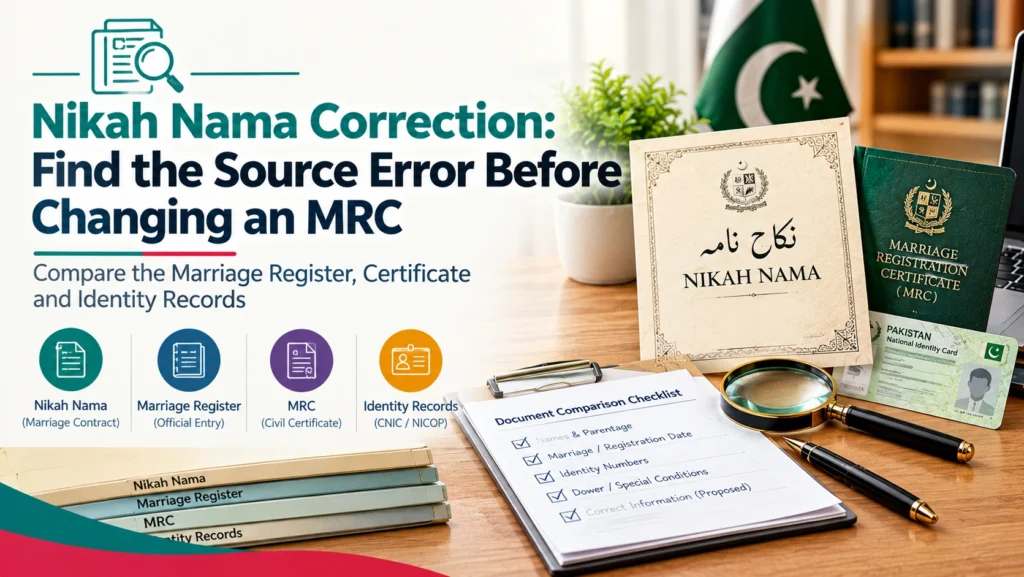
Compare the Marriage Register, Certificate and Identity Records
Identify Which Document Contains the Wrong Particulars
Nikah Nama correction begins with identifying the actual error, not choosing the easiest document to change. A spelling difference on an MRC, a mistaken identity number in the marriage register and a disputed dower entry are different problems. Compare the Nikah Nama with the other available records before asking an office to amend anything. The objective is an accurate, explainable record, not several papers that repeat the same mistake.
Court Marriage Services provides marriage-documentation and registration assistance through the Qanoon Group network. The service is private; only the competent authority or court can make the decision within its legal powers. For a preliminary documentation enquiry, use the Pakistan Legal Helpline and describe the disputed field, marriage city and document you need to use. Avoid posting complete records publicly.
Nikah Nama Correction is Different from MRC Re-Issuance
The Nikah Nama records marriage particulars and contractual terms. The register preserves the official marriage entry, while a computerised Marriage Registration Certificate presents civil-registration information through the issuing authority’s system. CNIC, NICOP and other identity records form another layer. A discrepancy may exist in only one layer or may have been carried forward into several documents.
If the registered Nikah Nama is accurate but a name was mistyped when the MRC was prepared, the enquiry normally concerns the certificate issuer’s correction process. If the underlying Nikah Nama entry is wrong, reprinting the MRC alone may reproduce the problem. If a current identity document is itself inaccurate, the relevant identity authority’s procedure may also be necessary. Do not assume one office can change every source.
Make a Field-by-Field Nikah Nama Comparison
Place the available Nikah Nama counterpart, a certified register entry if obtainable, MRC and relevant identity documents side by side. Record each difference exactly as it appears. Keep the original spellings and numbers in your working log, even when one seems obviously wrong. Your proposed correct Nikah Nama entry should be a separate column supported by evidence, not a silent alteration to the source material.
Our guide to the Nikah Nama and its recorded particulars explains the document’s purpose. It is useful background, but a general explanation cannot establish which version of a disputed fact is correct in your own file. That conclusion depends on the evidence and the procedure applicable to the record.
Build a Clear Discrepancy Log Before Requesting Correction
A short discrepancy log helps prevent different problems from being mixed together. It can also show an adviser or official why a Nikah Nama correction request is being made. Use a separate row for each Nikah Nama field, and distinguish what is recorded from what you believe should be recorded. If supporting evidence is unavailable, identify that gap honestly.
| Field to Compare | Question to Resolve | Useful Evidence to Identify |
|---|---|---|
| Name or parentage | Spelling variation or different identity? | Historical and current identity records |
| Marriage or registration date | Different events or an actual wrong date? | Signed record and register particulars |
| Identity number | Transposed digit or wrong person’s number? | Relevant official identity document |
| Dower or special condition | Copying error or contested agreement? | Complete counterparts and legal advice |
The table is an organising tool, not an official form or a finding that an amendment is permitted. A Nikah Nama may contain issues requiring more than a clerical correction. Keep a copy of the log as you update it, including the date and source of each new piece of evidence.
Check Whether the Nikah Nama Difference is Really an Error
Not every difference means the Nikah Nama is false. Urdu-to-English transliteration can produce more than one spelling, and an older document may use the name format that existed at the time. Compare identity numbers, parentage and other identifying facts before concluding that two records describe different people. A translator should identify the Nikah Nama source accurately, not rewrite it to create artificial consistency.
Likewise, the Nikah date and registration date may describe different events. A current residential address may legitimately differ from the historical address in the Nikah Nama. Explain these differences to the receiving institution and ask what supporting clarification it needs. Do not change a truthful historical entry merely because a later application form uses a different field or format.
Separate Transliteration from a Change of Identity
Where an English rendering causes the problem, retain the complete Urdu source and the translation together. Ask whether the issue concerns translation accuracy, the underlying Nikah Nama or the recipient’s document-matching requirements. A corrected Nikah Nama translation cannot amend the marriage register. Our English translation and overseas-use guidance explains the distinction between translating an existing record and using an English reference form.
Locate the Authority Responsible for the Incorrect Entry
Read the registration location and registrar details on the Nikah Nama, and the issuing-office particulars on the certificate. The relevant office may be the authority holding the marriage entry, the authority that issued the MRC or the authority responsible for an identity record. For an older Nikah Nama, local boundaries or record custody may have changed. Ask which successor office now controls the file rather than submitting repeated applications to an unrelated office.
Request the current Nikah Nama or certificate-correction procedure for the specific document and field involved. Confirm the application method, evidence, originals, attendance or representation requirements and fee payment route. The published registration process for a new certificate is not necessarily the procedure for amending an old entry. The marriage registration framework helps distinguish these stages without promising a single nationwide remedy.
Provincial Correction Rules Must Not Be Mixed Together
Local procedures can differ. For example, Khyber Pakhtunkhwa’s 2021 registration and certification rules include a formal certificate-correction process supported by documents and an amendment record. That example is not a national application form, nor does it establish the process for every Nikah Nama dispute. Ask the responsible office about the rules currently applicable to your own record.
Prepare Evidence for a Nikah Nama Correction Request
Keep the complete Nikah Nama, not just a cropped image of the disputed word. Surrounding particulars, signatures, registration references and dates may explain the difference. Obtain a certified entry where the authority’s process requires it or where comparison with the official register is necessary. Preserve the Nikah Nama counterpart you already hold even if a later copy appears clearer.
For a factual typing error in the Nikah Nama, identify the reliable document supporting the correct entry and explain how the mismatch arose, if known. If the request involves an older name, a previous passport or a changed identity document, retain the relevant history. Do not invent facts in an affidavit, assume a standard affidavit always suffices, or state that an official has already approved a correction when no decision has been made.
Know When a Nikah Nama Dispute is More Than a Typo
Disagreement about consent, identity, signatures, the existence of the marriage, dower or a special condition can affect substantive rights. It may be inappropriate to treat such a dispute as a routine counter-service correction. One spouse’s preferred wording does not automatically authorise an official to change the Nikah Nama against the other spouse’s account or the preserved evidence.
Seek case-specific legal advice about the Nikah Nama issue, available evidence and proper forum. Some matters can be handled administratively; others may require judicial determination or another lawful procedure. Neither “every correction needs a court order” nor “an affidavit fixes everything” is a reliable national rule. Do not use document repair to conceal an earlier marriage, remove an agreed obligation or backdate an event.
Preserve Every Nikah Nama Version During a Dispute
Retain each Nikah Nama counterpart, scan, translation and official response with its date and source. If two versions differ, label them separately rather than overwriting one file. A discrepancy may itself be important evidence. For wider context on the marriage contract and disputed entries, see Qanoon Group’s explanation of Nikah records and legal rights. It does not replace advice on the appropriate remedy in your case.
Follow Through After an Authorised Record Correction
Ask for the corrected Nikah Nama, certificate or other official evidence of the amendment according to the authority’s process. Compare it with the approved particulars before using it. Check whether only the MRC changed or whether the underlying Nikah Nama/register entry was also amended. Keep the earlier document and the correction trail; an authorised change should be explainable rather than hidden.
Then identify dependent applications that may need attention. A corrected marriage record does not automatically update every CNIC, NICOP, bank file, visa application or foreign civil registry. Our CNIC marital-status and identity-update guide discusses the separate NADRA process. Confirm the recipient’s requirements before submitting a revised Nikah Nama or MRC, especially if an earlier version was already filed.
Avoid False Shortcuts in Marriage Document Correction
Do not edit a Nikah Nama scan, cover a handwritten entry, copy a signature or ask a designer to produce a matching certificate. A document can look consistent while remaining legally inaccurate. Never accept a promise that a new Nikah Nama can simply replace the history of a previous marriage without the proper legal basis. Re-registration and another ceremony are not automatic answers to an error.
Be cautious if a provider cannot identify the issuing authority, refuses to explain the evidence required or promises an outcome before seeing the record. Ask for a clear scope of professional work and separate official charges. Processing time depends on the authority, the record and whether facts are disputed; a private appointment date is not a government completion guarantee.
Start with a Precise Nikah Nama Correction Enquiry
A useful enquiry states: the marriage location and date, whether the error is in the Nikah Nama or another document, the exact field, the entry currently shown, the evidence supporting the requested entry and the purpose for which the corrected document is needed. Mention any pending court case or existing official response. This helps prevent advice based on an incomplete or misleading summary.
Court Marriage Services can help organise a Nikah Nama correction file and identify the documentation issue for review. Do not send originals before confirming who needs them and how receipt will be acknowledged. The practical goal is to establish the correct source, follow the lawful route and preserve a reliable record of what was changed and why.
Questions About Nikah Nama and Marriage Record Corrections
Where should a Nikah Nama correction begin?
Begin by comparing the available counterpart, official register entry, MRC and relevant identity documents. Identify which source contains the error before approaching the authority responsible for that record.
Can NADRA correct the Nikah Nama directly?
NADRA identity records and the marriage-register record are different systems. An identity correction may be a NADRA matter, but it does not automatically authorise NADRA to rewrite the underlying marriage contract or local register.
What if only the computerised MRC has a spelling error?
Approach the issuing authority with the correct underlying record and ask for its certificate-correction procedure. Do not assume the registered Nikah Nama must be changed when it already records the correct particulars.
Does every Nikah Nama correction require a court order?
No universal rule is stated here. The route depends on the field, evidence, applicable local rules and whether facts or rights are disputed. Obtain advice before treating a substantive dispute as a clerical correction.
Can an affidavit alone correct a marriage document?
Not automatically. An affidavit may be relevant evidence where required, but it does not itself amend an official register or compel the authority to accept the proposed facts.
Should the marriage date and registration date always match?
Not necessarily; they may record different events. Check the labels and underlying evidence before requesting a change. Never replace a truthful date merely to make two different fields look identical.
Can a translation fix a wrong entry in the Nikah Nama?
No. A translation should accurately reflect the source. A translation error can be addressed as such, but a mistake in the underlying record requires the appropriate record-correction process.
Can one spouse change disputed dower terms as a typing correction?
A disagreement about agreed dower or contractual terms may involve substantive rights. Preserve the evidence and obtain advice on the proper forum; a unilateral request is not automatic authority to change the recorded agreement.
Will a corrected MRC automatically update my CNIC or NICOP?
No automatic update should be assumed. The relevant NADRA modification process and other receiving institutions’ requirements must be checked separately after the marriage-record issue is resolved.
Should I destroy the old document after correction?
No. Retain it with the official correction evidence and revised document. A clear amendment trail helps explain earlier submissions and avoids confusion about different versions of the record.
Need help identifying the right correction route?
Share the marriage city, the document containing the discrepancy and the field that needs review. Confirm the applicable process and charges before sending sensitive documents.