
MARRIAGE RECORDS · CONFIDENTIAL DOCUMENT HANDLING
Court Marriage Privacy: Registration Records and Responsible Document Sharing
Understand lawful access to registered records, limit unnecessary sharing of sensitive documents and set realistic confidentiality expectations before your appointment.
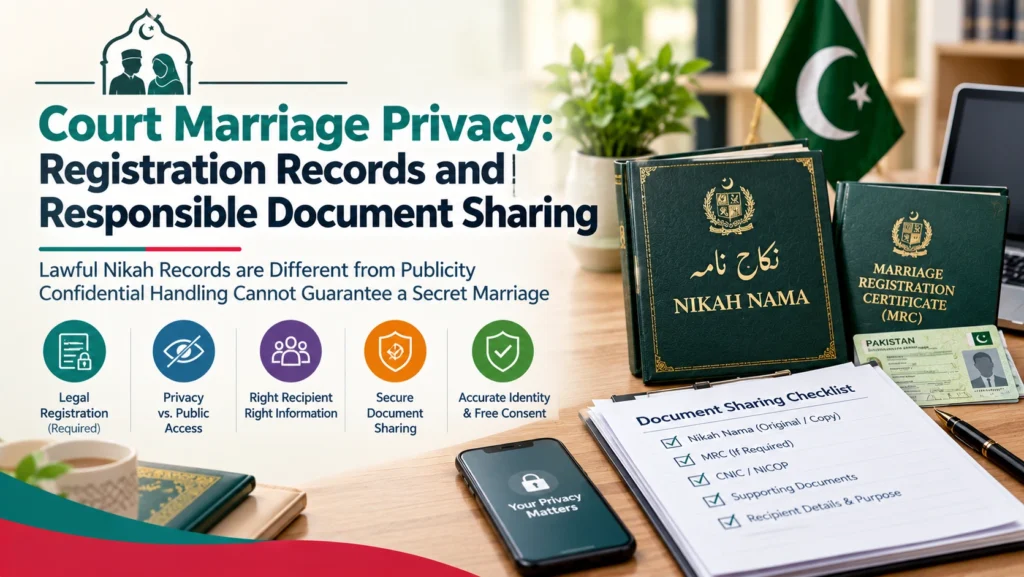
Lawful Nikah Records are Different from Publicity
Confidential Handling Cannot Guarantee a Secret Marriage
Marriage privacy means limiting unnecessary circulation of personal information while completing lawful Nikah and registration requirements. For eligible couples in Pakistan, a discreet appointment is different from an invisible official record. Before sharing documents, understand who needs them, why they are needed and what a service provider can realistically keep confidential.
Court Marriage Services, the matrimonial legal-services platform of Qanoon Group, provides documentation and registration assistance. That professional role does not give the firm control over government registers, court files or another person’s lawful access rights. Court marriage privacy should therefore be discussed as a practical arrangement, never sold as guaranteed secrecy.
Discuss marriage privacy and document handling through our Pakistan Legal Helpline (WhatsApp). Start with the city, whether a Nikah has already taken place and the concern requiring advice. Ask how supporting documents should be supplied before sending an entire identity or marriage file.
Marriage Privacy and Access to Registered Records
The Muslim Family Laws Ordinance, 1961 requires Muslim marriages to be registered. Section 5(6) also permits any person, on payment of the prescribed fee where applicable, to inspect the preserved Union Council record or obtain an entry copy. Marriage privacy is therefore not a promise that only the spouses can access the register.
The applicable provincial or territorial law and the office holding the record must still be checked. Understanding this distinction helps set realistic marriage privacy expectations: statutory access does not mean every person’s marriage documents are displayed on a public website. Nor does it entitle a private intermediary to demand your account password or pretend to be you.
A Register Search is Not the Same as an Online Lookup
A request made through the competent record office differs from an unofficial internet service offering to reveal marriages by CNIC. Uploading identity documents to test unknown websites creates a marriage privacy risk. Use our marriage certificate verification guide to distinguish a certificate check from a claimed personal-history search.
Ask the relevant authority about its current application, identification and fee procedure. A provider who says marriage privacy makes official enquiries impossible is overstating its powers. Obtain advice on the actual record and jurisdiction rather than relying on an assurance printed in an advertisement.
Marriage Privacy Depends on Who Needs Your Nikah Documents
Different recipients need different information. A registrar may need prescribed identity and marriage particulars; a lawyer may need enough evidence to assess the issue; a translator needs the document being translated. Marriage privacy improves when these purposes are separated instead of circulating one oversized folder to everybody involved.
Ask for the document list and the reason for each item. This is a marriage privacy safeguard, not permission to omit information legally required for registration. If an office asks for an unfamiliar document, seek clarification through its established contact route rather than assuming that the request is either mandatory or fraudulent.
Keep a Purpose-Based Sharing Record
A simple list helps you remember what was supplied, to whom, on which date and for what task. Your marriage privacy checklist should also identify whether each recipient received an original, scan, translation or certified copy. Record an expected return date for originals without inventing a processing deadline for the authority.
If several relatives or intermediaries are helping, nominate a contact for routine coordination while preserving each spouse’s ability to give their own instructions. An informal coordinator should not silently become the decision-maker. A marriage privacy arrangement must not prevent either person from understanding the documents or obtaining independent advice.
Protect Marriage Privacy Before the Appointment
Tell the office whether a telephone number or email account is shared and whether a message preview could expose sensitive information. Ask for a suitable contact method and agreed appointment communication. Court marriage privacy starts with realistic instructions: the office cannot infer that a familiar-looking number is unsafe for you.
State any objection to photography, video recording, testimonials or social-media publication before the appointment. Necessary identity or procedural records are a separate matter and should be explained. Consent to legal assistance should not be assumed to mean consent to an advertising image; ask how marriage privacy will be respected in practice.
Accurate Identity and Free Consent Remain Essential
Privacy does not justify false names, altered dates, concealed marital status or an inaccurate address where truthful particulars are required. Age, legal capacity, consent and any previous marriage must be assessed under the applicable law. Court marriage privacy cannot replace those checks or cure an unlawful arrangement.
A person who feels pressured should have the opportunity to raise concerns independently. Do not sign an incomplete form simply because someone says fewer questions will protect marriage privacy. Read the entries, understand the agreed terms and ask how corrections should be made before any document is signed.
Share Nikah Nama Copies Without Damaging the Record
Keep the complete original and any official certified copy intact. For an initial enquiry, ask whether a limited working copy is sufficient before sending the full record. Marriage privacy may justify reducing unnecessary exposure during a preliminary discussion; it does not justify changing the version submitted as official evidence.
Where the recipient accepts a redacted working copy, clearly identify it as such and keep the unaltered source separately. Do not cover signatures, registration details or other necessary fields in a formal submission without the receiving authority’s agreement. Poorly planned redaction can create avoidable doubts about authenticity and weaken marriage privacy safeguards.
Label Working Copies and Check Every Attachment
Use filenames that identify the document and version without broadcasting unnecessary personal details. Check every page and attachment before sending, particularly when a folder contains another person’s CNIC or a previous marriage record. One mistaken attachment can defeat otherwise careful marriage privacy arrangements.
Accuracy and marriage privacy need separate safeguards: do not paste an official signature or seal into a newly prepared document or digitally repair a date to make records agree. An error needs the proper correction route. Our guide to registered Nikah records explains why the underlying record matters.
Marriage Privacy When Phones and Accounts are Shared
Review who can open the device or account used for the enquiry. Shared cloud folders, linked computers, automatic photo uploads and visible notifications can expose documents outside the intended conversation. Court marriage privacy is affected by the devices at both ends, not only by the name of the messaging application.
Ask the recipient to confirm the correct address or number through an established channel before sending sensitive material. Be cautious when somebody unexpectedly requests an OTP, account password or remote access to your phone. Marriage privacy does not require handing over control of your identity or communication accounts.
Protect the Channel Without Destroying Evidence
Preserve originals and records relevant to an actual or anticipated legal dispute. Do not delete messages, alter files or discard documents to frustrate a lawful investigation or proceeding. Discuss secure storage and necessary retention with your adviser; marriage privacy and evidence preservation need to be considered together.
Treat a misdirected file as a marriage privacy concern: record what happened and inform the intended professional contact promptly. Ask about a proportionate response, including seeking deletion where appropriate, but do not assume a recall request removes every copy. Avoid sending additional personal data while trying to explain the mistake.
Family Opposition Needs a Separate Safety Assessment
Distinguish embarrassment or unwanted publicity from threats, coercion, stalking or violence. Marriage privacy alone is not a safety plan. Where there is an immediate threat, prioritise reaching a safe place and contacting the appropriate emergency or police service; an ordinary document enquiry is not an emergency-response channel.
For a legal assessment, explain the actual conduct, dates, people involved and any existing complaint or proceeding. Do not manufacture allegations or supporting evidence. Court marriage privacy cannot guarantee protection, prevent all enquiries or automatically resolve an existing criminal or family-law matter.
Protection Requests Have Their Own Disclosure Rules
When threats complicate marriage privacy, ask a lawyer which facts and documents a proposed complaint or court application would require and who may receive them. Any lawful protective measure depends on the case and competent authority. Qanoon Group’s guidance on free-will marriage and protection provides related legal context without promising an automatic order.
Do not withhold a material case document from your lawyer because it seems inconsistent with marriage privacy. Accurate instructions are necessary to assess the risk. Explain confidentiality concerns directly so that lawful handling, necessary disclosure and any available protective application can be considered on the real facts.
Overseas Marriage Documents and Third-Party Handling
A visa, sponsorship or civil-status application may require marriage evidence, translations or authentication. Request the current checklist from the receiving institution before instructing several agents. Marriage privacy is better served by a defined document route than by sending the same full file to speculative contacts.
Identify who will translate, collect, authenticate and submit each document, and whether another subcontractor will receive it. Ask how originals will travel and be returned. Marriage privacy does not guarantee foreign acceptance: the embassy, immigration office or other receiving authority decides its own evidentiary requirements.
Confirm the Recipient Before Sending a Full File
Match the recipient’s identity and task with the appointment or engagement you actually arranged. A forwarded message or logo is not enough. Assess marriage privacy before disclosing records concerning a former spouse or a child: ask whether the receiving process needs them and how unnecessary circulation can be avoided.
Questions to Ask About a Marriage Privacy Promise
Ask concrete questions before relying on a general statement of confidentiality. Who handles the file? Which authority will receive it? Will an assistant, courier or translator see it? Are photographs optional? What records will be retained? Useful marriage privacy commitments explain the workflow and its limits.
Reject assurances that an official marriage can be made permanently untraceable or that the registrar will ignore a legally required entry. A legitimate court marriage privacy discussion concerns careful handling, not fabricated records, omitted registration or evasion of lawful disclosure. The same distinction applies to a higher-priced package described as confidential.
Plan the Record Handover with Marriage Privacy in Mind
Before the work finishes, confirm which documents each spouse will receive and which registration or certificate step remains pending. Keep the relevant authority’s name and any available reference details with the file. Marriage privacy should not leave one person dependent on another person for every future document request.
Separate professional charges, official fees and any courier or translation expense in the agreed scope. No additional payment can purchase a universal exemption from lawful record access. Discuss marriage privacy concerns specific to your case through the Court Marriage Services contact page and request a document-handling discussion before sharing sensitive attachments.
This guidance concerns responsible handling of Muslim marriage records in Pakistan. Other personal-law marriages, foreign records and court proceedings require their own assessment. Marriage privacy requires current, case-specific decisions. Confirm the applicable law, local procedure and facts before acting; do not treat a general guide as an individual legal opinion.
Court Marriage Privacy Questions
Is a court marriage completely secret in Pakistan?
No. A discreet appointment does not make the official record inaccessible. Muslim marriage registration law provides for inspection and copies of preserved entries, subject to the applicable framework. A provider should not guarantee permanent secrecy.
Can only the spouses obtain a registered Nikah entry?
Do not assume spouses-only access. Section 5(6) of the Muslim Family Laws Ordinance permits any person to seek inspection or an entry copy on payment of the prescribed fee where applicable. Confirm the procedure with the competent record office.
Does lawful access mean anybody can search marriages online by CNIC?
No. A statutory record-access procedure is different from an unrestricted internet lookup. Use the responsible authority’s actual process rather than entering identity details into an unofficial website.
Can I ask that ceremony photographs are not published?
Yes, raise that instruction before the appointment and ask how it will be recorded. Distinguish optional photographs or publicity from any documentation genuinely required for the legal or registration process.
Should I send my full CNIC and Nikah Nama in the first message?
First verify the recipient and ask what is needed for the particular enquiry. A short description of the city, existing documents and issue may establish the next step before sensitive attachments are requested.
Can I redact a marriage document before sending it?
Ask whether the recipient accepts a clearly labelled redacted working copy for preliminary advice. Keep the original intact. Official submissions may require complete documents; do not obscure required information without agreement from the receiving authority.
Does an online Nikah offer stronger marriage privacy?
Not automatically. Remote arrangements can involve messaging accounts, devices, representatives and document transfers. The applicable consent, legal-capacity and registration requirements still need to be met, and each communication channel needs careful handling.
Can a free-will affidavit prevent all police enquiries?
No. An affidavit may be relevant evidence but does not prevent lawful enquiries or automatically produce protection. An existing complaint, threat or proceeding needs a separate assessment based on accurate documents and facts.
Can the registrar omit registration to protect marriage privacy?
Privacy is not a reason to avoid the registration required for a Muslim marriage. Ask how documents will be handled discreetly while the correct legal record is completed, rather than requesting missing or false entries.
What should I discuss before paying for confidential assistance?
Clarify the service scope, document recipients, contact arrangements, handling of originals, publicity preferences, retention and remaining authority steps. Obtain a realistic explanation of confidentiality limits rather than relying on an absolute secrecy promise.
Discuss Document Handling Before You Share Your File
Describe the document, registration city and privacy concern first. Confirm the scope and the applicable authority’s requirements before sending sensitive attachments.