
MARRIAGE CONSENT AND DOCUMENTARY EVIDENCE
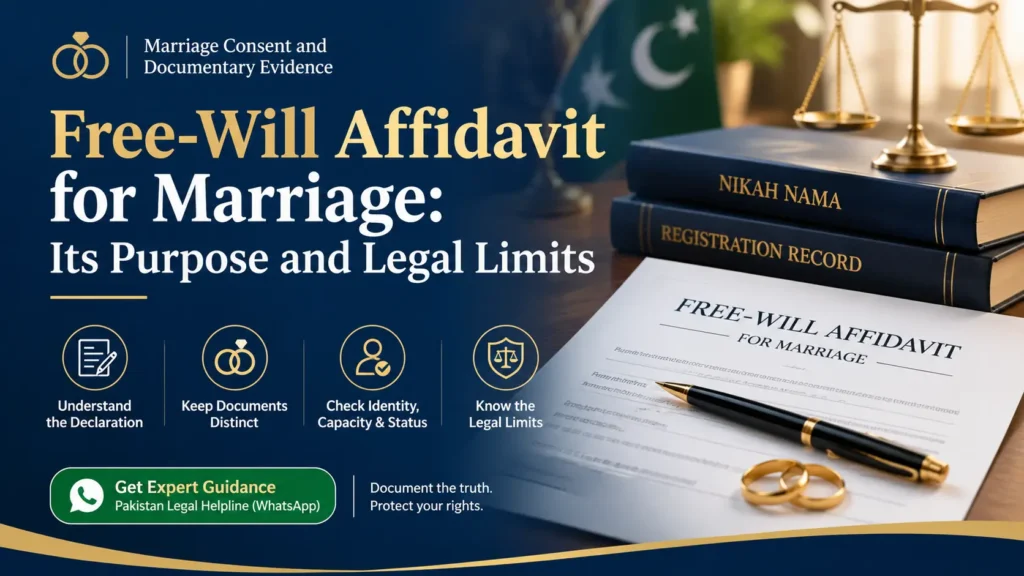
Free-Will Affidavit for Marriage: Its Purpose and Legal Limits
A practical guide to voluntary declarations, marriage records and the legal limits of an affidavit.
Separate a Personal Declaration from the Marriage Contract
Free-will affidavit preparation should begin with a clear question: what fact is the person being asked to declare, and who needs that declaration? In a marriage matter, a statement about voluntary choice is not the same document as the Nikah Nama, a registration entry or a court order. Each has a different purpose, and none should be described as doing the work of all the others.
A free-will affidavit may record the maker’s account of their decision and relevant circumstances. Its significance depends on truthful contents, proper execution, the applicable process and the evidence surrounding the case. It is not a private licence to disregard eligibility requirements, and it does not settle every possible disagreement about a marriage.
Court Marriage Services provides private marriage-documentation and registration assistance through the Qanoon Group network. For an enquiry, contact the Pakistan Legal Helpline (WhatsApp) with the proposed marriage location, document requested and intended use. Establish the task before sending a complete identity file.
Understand What the Declaration Actually Says
Distinguish the Maker’s Statement from an Official Finding
A free-will affidavit is a statement made by its identified maker, often called the deponent. A declaration that a decision is voluntary records that person’s account; it should not be rewritten as an official finding that every legal condition has been satisfied. The wording must stay tied to facts the maker understands and can honestly explain.
Read it sentence by sentence. Identify whether it describes a proposed marriage, a marriage said to have occurred, or a response to an allegation. These are different factual situations. A document prepared before solemnisation should not falsely state that the ceremony has happened, and later preparation must not be disguised with an earlier date.
Where it mentions another person’s conduct, distinguish personal knowledge from information received from somebody else. Do not insert a stock accusation because it appears in a downloaded form. Discuss uncertainty with the adviser rather than converting an assumption into a sworn assertion.
Keep the Affidavit, Nikah Nama and Registration Record Distinct
The affidavit and Nikah Nama answer different questions. The affidavit may explain a person’s account of voluntary choice; the Nikah Nama records marriage particulars and contractual entries through the prescribed framework. Dower, special conditions and other relevant entries belong in the marriage documentation, not an unrelated declaration.
Section 5 of the Muslim Family Laws Ordinance registration framework requires registration of marriages solemnised under Muslim law. An affidavit does not replace that process. Confirm current provincial or territorial requirements and the competent local authority. Our marriage documents guide explains the wider paperwork context.
| Document | Main purpose | Do not assume |
|---|---|---|
| Free-will affidavit | What its maker declares | It creates a marriage or decides a dispute |
| Nikah Nama | Marriage particulars and terms | It can be replaced by a declaration |
| Registration record or MRC | Official marriage record or certificate | A private receipt proves registration |
| Court order | What the court directed or decided | An affidavit has equivalent authority |
Check Identity, Capacity and Marital Status Separately
Do not use an affidavit to conceal identity discrepancies or replace reliable age evidence. If names, dates or identity particulars differ, identify the difference before proceeding. An assertion of eligibility does not remove the need to check the facts and law applicable at the proposed place of marriage.
Legal-age requirements must be assessed under the current relevant jurisdiction, not an old nationwide checklist. A declaration of agreement cannot make an otherwise prohibited arrangement lawful. Previous marital status also needs separate review: do not describe someone as unmarried because a relationship ended informally or records are unavailable. For divorce, widowhood or an existing marriage, disclose the actual position and obtain advice.
Make Understanding and Voluntary Instructions Central
Resolve Language or Pressure Concerns Before Signing
Before signing, the maker should understand every factual statement and its purpose in a language they understand. Do not rely on a hurried assurance that the text is standard. The affidavit should reflect the maker’s own instructions, not merely the preferences of the person arranging the appointment.
Do not sign a blank or partly completed affidavit. Check names, dates, the proposed or actual event described, and any declaration concerning pressure or previous marital status. If changes are needed, ask the responsible professional how to finalise them; do not permit somebody to add material statements later without the maker’s knowledge.
Recognise the Evidentiary Limits of a Free-Will Affidavit
Ask who is authorised to administer or attest the affidavit for its intended use and what identification, attendance or execution requirements apply. A stamp, seal or signature is not proof that a court has approved the marriage. Different recipients may require different formalities.
The evidentiary value can be contested. In a Sindh High Court marriage-document dispute, the courts examined the alleged marriage and supporting evidence rather than treating documents as conclusive. The lower findings were left undisturbed on that particular record; this is not a prediction about another case.
Retain genuine evidence and do not promise that an affidavit prevents every challenge. If execution, identity or the marriage itself is disputed, the legal process may examine witnesses, records and surrounding circumstances. Preparing an affidavit does not guarantee an outcome.
Do Not Confuse a Declaration with Protection or Immunity
An affidavit is not itself a protection order, bail order or direction to a police officer. An existing complaint, allegation or court proceeding requires separate assessment. Explain the actual matter to a lawyer and preserve relevant records; do not assume one document automatically ends every enquiry.
If the affidavit is proposed for use in proceedings, ask how it relates to the application or response being prepared. The relevant court or authority decides matters within its powers. Any request for relief must accurately describe the facts and order sought, not imply relief already exists.
Prepare the Free-Will Affidavit File Without Manufacturing a Story
Organise the enquiry around a chronology: who requires the document, what event it concerns, whether the Nikah has occurred and what records exist. Mark uncertain dates as uncertain. Keep the complete affidavit with execution details and associated instructions or acknowledgements, and retain the Nikah Nama and registration papers separately. See our Nikah Nama guide for the underlying contract record.
If there is a mistake, preserve the executed version and explain whether it has been submitted. Ask about the proper correction or fresh-statement procedure. Editing a scan, copying a signature or silently replacing a page can create a new problem.
Discuss professional scope and charges before payment: drafting, explanation, execution arrangements or advice about an existing case. Identify official expenses and separate registration work where applicable. A private fee does not purchase guaranteed acceptance by a court, registrar or foreign institution.
Keep Submission and Response Details with the File
When submitting the affidavit, retain exactly what was supplied and note the recipient, date and application reference. Keep any acknowledgement and covering message with that version. If the recipient questions it, retain the written response and identify whether the issue is an identity mismatch, missing execution detail or another supporting document.
Compare any request for a fresh affidavit with earlier instructions. Identify changed facts, statements that remain accurate and the new purpose. Keep the previous version rather than overwriting it. If different recipients need different material, maintain a short schedule recording which version each received and what remains outstanding.
Choose the Next Step According to the Actual Document Need
Before commissioning an affidavit, ask the requesting person or institution to identify its purpose. Is it a supporting declaration, evidence in a dispute or part of an administrative file? If the actual need is registration, use the registration process guide and confirm the responsible authority.
For wider context, Qanoon Group’s guidance on marriage by free consent addresses the right and its legal setting. An affidavit remains a supporting statement, not a replacement for applicable marriage conditions or a determination of contested facts. Court Marriage Services can help identify the documentation issue and the separate steps that remain necessary.
Questions About Free-Will Marriage Affidavits
Does a Free-Will Affidavit Create a Marriage?
Is This Affidavit Compulsory for Every Marriage in Pakistan?
Does Attestation Mean a Court Has Approved the Marriage?
Can the Declaration Replace the Nikah Nama?
Can an Affidavit Override an Age Restriction?
What If the Maker Does Not Understand the Language?
Can an Affidavit Prevent Every Police Enquiry?
What If Someone Disputes the Signature or Marriage?
Should an Incorrect Executed Affidavit Be Edited Digitally?
What Should I Ask Before Paying for Preparation?
Need Help Identifying the Right Marriage Document?
Share the document requested, its intended use and the relevant location. We can help identify the documentation question and separate steps that may need review.