
MARRIAGE DOCUMENTS FOR OVERSEAS USE
Apostille for Marriage Documents: Prepare the Right Overseas Evidence
Prepare the right marriage records for overseas use—without confusing registration, translation and authentication.
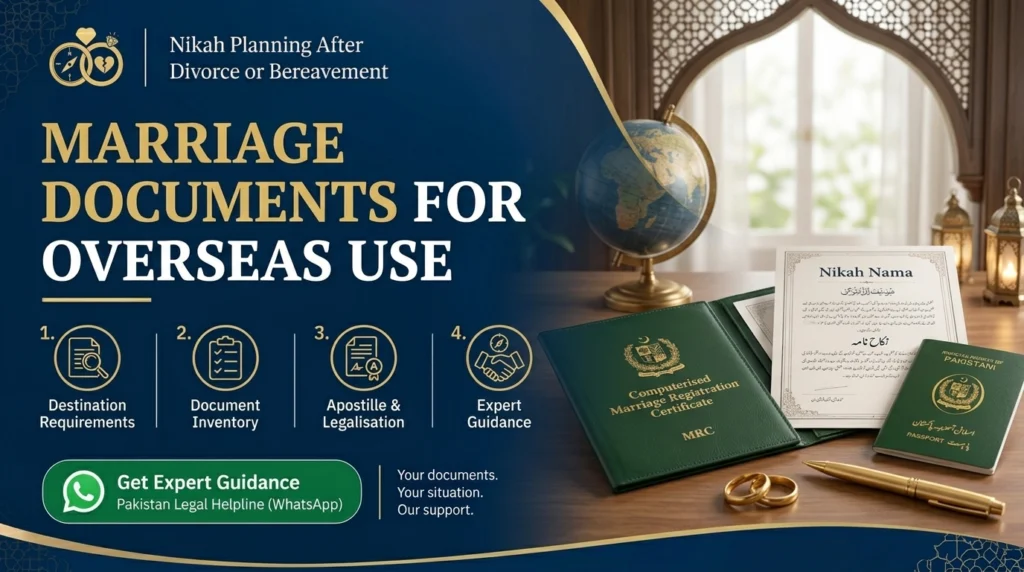
Separate Marriage Registration from Document Authentication
Apostille for marriage documents begins with the destination authority’s requirements and the actual marriage document, not with buying a stamp. A couple may hold a Nikah Nama, a computerised Marriage Registration Certificate and an English translation, yet still need to establish which document the overseas institution wants authenticated. Treat those papers as related records with different functions, rather than interchangeable versions of one certificate.
Court Marriage Services is a private matrimonial-services platform within Qanoon Group. We can help organise a marriage-document enquiry and identify questions requiring professional review; we do not issue an Apostille or decide a foreign authority’s application. Contact the Pakistan Legal Helpline (WhatsApp) with the document type, issuing location, destination country and intended use before sending sensitive attachments.
What an Apostille Establishes—and What It Does Not
An Apostille concerns the origin of a public document: the signature, the signatory’s capacity and, where relevant, the seal or stamp. It does not certify that every statement in the document is true. Nor does an Apostille turn an inaccurate record into an accurate one, amend a marriage contract or decide a disputed marriage’s validity.
The HCCH Apostille framework replaces traditional legalisation with a certificate from a competent authority where the Convention applies. Check the route for the particular issuing and receiving countries. A country’s appearance on a general membership list is not a sufficient substitute for checking whether the Convention operates in the relevant relationship and for the document concerned.
Keep authentication separate from the receiving institution’s substantive decision. An Apostille does not promise a visa, sponsorship approval, residence status or automatic recognition of every marriage arrangement. Ask the institution about the evidence it needs for its actual process. A provider who guarantees the final immigration result simply because an Apostille is obtained is combining two different decisions.
Start with the Receiving Authority’s Written Checklist
Identify the office that will use the documents: an immigration authority, civil registry, university, employer or court may have different requirements. Ask for its current checklist and retain the reply. Before requesting an Apostille, establish whether it wants the Nikah Nama, the MRC, both records, a translation or additional evidence explaining names and dates.
For Apostille planning, record the required language and whether the institution specifies a translator, certification method, original document or acceptable copy. Ask whether the Apostille should relate to the underlying record, a qualifying certified copy or another document in the file. Do not assume a relative’s successful application last year establishes the current requirement for your different destination or purpose.
Ask Precise Questions Instead of Buying a General Package
A useful request states the issuing country, document name and intended procedure. For example, ask whether a registered Urdu Nikah Nama and its translation are needed alongside an MRC, and which authentication route applies. This is an information request, not a suggested answer. Keep the institution’s own wording rather than replacing it with an agent’s shorthand.
If the reply only says “attested marriage certificate”, seek clarification before ordering an Apostille. That expression may leave the document, issuing authority and authentication route unresolved. A small clarification at this stage can prevent paying to authenticate one record while the receiving office is waiting for another.
Check the Marriage Record Before Arranging an Apostille
Compare the complete Nikah Nama and MRC with the identity records relevant to the application. Check names, parentage, dates, identity references and issuing particulars. Do not crop away a margin or reverse page that contains registration information. An Apostille enquiry should begin with a readable, complete record whose source can be explained.
Distinguish a document that is missing from one that was never issued or registered. A clear scan is useful for an initial assessment, but it is not automatically an acceptable original or certified copy. Our marriage registration guide explains the underlying registration stage. The Apostille process is a later authentication enquiry, not a replacement for that stage.
If two documents disagree, identify the problem before submitting an Apostille application. A translation error, certificate typing error and disputed contractual entry require different responses. Preserve each version and its source. Never change a scan, paste a signature or hide a date merely to make the file look consistent.
Prepare a Document Inventory, Not an Unchecked Bundle
For the Apostille file, list each item separately, including its issuer, language, whether it is an original or copy, and why the recipient needs it. Mark any missing page or unclear entry. The inventory below is a planning tool for an Apostille enquiry, not an official application form or universal documentary checklist.
| Item to Identify | Question to Resolve | Keep with the File |
|---|---|---|
| Nikah Nama | Is the complete registered record available? | Issuer and registration references |
| MRC | Does the recipient require this certificate? | Issuing-office particulars |
| Translation | Which language and certification are accepted? | Source document and translator details |
| Authentication | Apostille or another legalisation route? | Current authority instructions |
Keep separate entries where two spouses hold different counterparts or where an institution has already received an earlier version. That history can matter when an Apostille file is queried. Do not silently replace the document in an existing application without checking how the receiving institution wants a correction or supplementary submission recorded.
Use the Current MOFA Route for the Particular Document
Pakistan’s Ministry of Foreign Affairs publishes requirements for Nikah Nama and MRC authentication, including supporting identity or family records and particular situations involving online marriages, foreign spouses or overseas-issued records. Consult the current MOFA document-attestation guidance for the category that actually applies. Do not combine selected requirements from several categories into an invented universal list.
MOFA’s published notice requires prior online registration for Apostille requests from 27 July 2026. Follow the official page’s current application link and instructions before travelling or arranging collection. Online registration should not be described as proof that the documents have passed review, and a submitted Apostille application is not the same as an issued certificate.
Check the current instructions for originals, representation, appointment arrangements and any authorised submission channel. Record the application reference and any request for further information. Because procedures can change, avoid relying on an old screenshot of an Apostille booking screen or a claim that an unofficial intermediary has a permanent exemption from the process.
Foreign-Issued Documents Need Their Own Route
Tell the adviser where the marriage document was issued, not just the spouses’ nationalities or present address. A document issued abroad should not automatically be treated as a Pakistani-issued record for Apostille purposes. Identify the originating authority and ask the receiving institution which authentication chain is required for that actual document.
The same care applies when a file contains records from more than one country. A Pakistani MRC, foreign divorce record and overseas translation may each raise different authentication questions. Put those questions in separate rows of the working file. One Apostille attached to one item should not be assumed to authenticate every other paper travelling with it.
Coordinate Translation Without Altering the Source
A translation accompanying an Apostille should accurately represent the document being translated. It should not improve an inconvenient entry, substitute a new marriage date or conceal a previous name. Ask the receiving institution whether translation should occur before or after the Apostille and whether the certificate itself also needs translation. The right sequence depends on its stated requirements.
Our English Nikah Nama and translation guide distinguishes an English reference form from a translation of an existing record. An Apostille does not make a blank English form into evidence of your marriage. Keep the translator’s output linked to the precise source version used.
Check names, numbers and page references across the translation and source without privately rewriting either. If a discrepancy is found, ask the appropriate professional or issuing authority how it should be resolved. Retain the correction trail. A well-organised Apostille file explains changes rather than pretending that an earlier version never existed.
Keep Charges, Custody and Progress Transparent
Ask for a written scope separating professional assistance, official charges, translation and delivery costs. A quotation for “complete attestation” should identify the documents and tasks included. No fee or universal completion period is promised here. The current Apostille charge and processing arrangements should be checked through the official channel for the selected service.
Before handing over originals, confirm who receives them, how receipt is acknowledged and how return will be arranged. Keep an inventory and copies for your own reference. Do not hand over account passwords or verification codes merely because someone offers to coordinate an Apostille application. Agree on a lawful way to provide the necessary information without surrendering control of unrelated accounts.
Use clear status descriptions in correspondence: information collected, application submitted, additional material requested, authentication issued, documents returned. Avoid describing an Apostille as complete while an essential authority step is pending. If an overseas deadline is approaching, tell the receiving institution what has actually been completed and ask about any permitted extension or supplementary submission.
Review the Returned File Before Sending It Overseas
When the Apostille file returns, check that the authenticated item is the document you submitted and that all pages and attachments remain together. Follow the issuing authority’s verification instructions where available; do not enter personal details into a lookalike website found through an advertisement. An Apostille verification enquiry should use the genuine authority’s route.
Then compare the completed Apostille package with the recipient’s checklist one final time. Confirm language, copies, delivery method and any reference number that must accompany it. Retain a complete copy of what was sent and proof of delivery where available. This practical record makes a later query easier to answer without repeatedly circulating original documents.
For background on the marriage contract and statutory record, see Qanoon Group’s Nikah and registration guidance. For an Apostille enquiry, bring that underlying record together with the destination’s requirements. The useful outcome is a correctly prepared, traceable document file—not a promise that authentication alone settles every legal or overseas decision.
Questions About Marriage Documents and Apostille Preparation
Is an Apostille the Same as Marriage Registration?
Does an Apostille Prove Every Statement in My Nikah Nama?
Will Every Foreign Authority Accept the Same Marriage Document?
Should I Obtain an Apostille on the Nikah Nama or MRC?
Can Authentication Fix an Incorrect Name or Date?
Does an Online Nikah Remove Document Checks?
Can I Travel to MOFA Without Checking the Online Process?
Must the Translation Always Be Prepared First?
Does a Pakistani Apostille Authenticate a Foreign-issued Certificate?
Does Successful Authentication Guarantee a Visa?
Need Help Organising Marriage Documents for Overseas Use?
Share the document type, issuing location, destination country and intended use in your initial enquiry. Do not send sensitive attachments before the requirements are clear.